
Clay Soil Drainage in Tulsa: Why Your Yard Holds Water
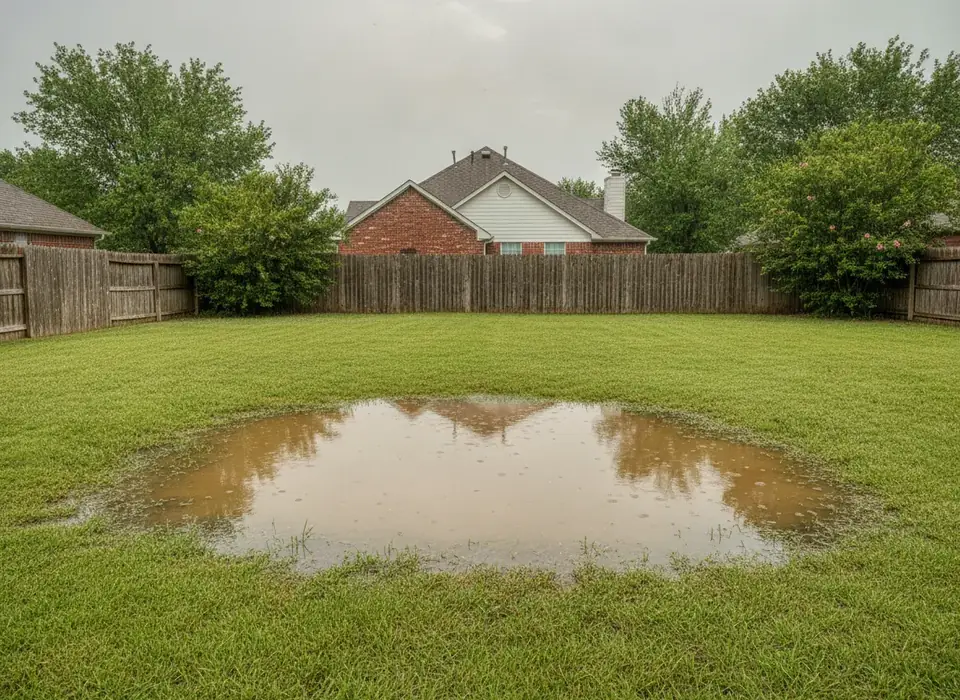
If your Tulsa yard stays squishy for days after a storm, the soil is usually part of the story. Much of Tulsa County sits on clay that takes in water slowly, swells when wet and shrinks when it dries out. This post explains what the USDA soil data says about Tulsa ground, why it holds water, and which drainage fixes tend to suit clay. It's general information to help you talk to contractors, not a site assessment.
Tulsa French Drain Pros is a free matching service, not a drainage contractor. Independent local companies who reply to your request can look at your actual lot.
What kind of soil does Tulsa have?
The USDA soil survey for Tulsa County lists dozens of soils, but a handful dominate. About 47% of the county is soil with a high or very-high shrink-swell rating. The single largest soil, Dennis silt loam, covers about 20.6% of the county and is rated "somewhat poorly drained."
| Soil | Share of county | USDA drainage class | Shrink-swell |
|---|---|---|---|
| Dennis | 20.6% | Somewhat poorly drained | High |
| Radley | 6.2% | Moderately well drained | Moderate |
| Okemah | 5.8% | Somewhat poorly drained | High |
| Wynona | 4.0% | Somewhat poorly drained | High |
| Eram | 3.9% | Moderately well drained | High |
| Parsons | 3.4% | Somewhat poorly drained | High |
| Osage | 3.3% | Poorly drained | Very high |
Not every Tulsa lot is clay. Sandy and loamy soils show up along the Arkansas River terraces and bottoms. But on a typical Tulsa, Broken Arrow or Owasso lot, expect a clay subsoil not far below the topsoil, plus fill and compacted dirt from when the house was built.
Why clay soil holds water
Clay particles are tiny and packed tight, so water moves through them slowly. In the NRCS data, the slowest layers of Dennis and Okemah soils pass water at roughly a tenth of an inch an hour or less, and Parsons, Osage and Pharoah are slower still. When a storm drops more than that, the extra water has nowhere to go but sideways and downhill, or into the lowest spot in your yard.
Tulsa gets plenty of rain to test that. NOAA's 1991 to 2020 normals for Tulsa International Airport show about 41 inches a year and about 12 days a year with an inch or more. May is the wettest month at 5.73 inches, and April through June brings about 36% of the year's rain. Put heavy spring storms on slow clay and you get standing water, soggy side yards and water sitting against the slab.
Clay, slabs and foundations
About 98% of new homes in the region are built slab-on-grade (2024), so basements are rare. Expansive clay swells when it's saturated and shrinks in summer drought. When downspouts dump water at one corner of a slab, or the grade slopes toward the house, the soil under that part of the house gets wetter than the rest. Good drainage can help reduce moisture swings in Tulsa's clay soils. It isn't foundation repair, and if you're seeing cracks or sticking doors, that's a question for a foundation specialist, a separate trade.
Does a French drain work in clay soil?
Yes, but think of it as a gutter in the ground, not a sponge. In sandy soil a drain can let water soak out along its length. In Tulsa clay, very little soaks out. The drain's job is to collect water from the surface and the top layer of soil and carry it to an outlet. That has three consequences:
- The outlet matters most. A French drain that ends in a buried pit in clay may simply fill up. The water needs a daylight exit, a pop-up emitter on lower ground, or a run toward the street. See where a French drain should outlet.
- Slope has to be right. Because the pipe is carrying the water, it needs a steady fall from start to finish.
- Silt is the long-term enemy. Fine clay and silt can work into gravel and pipe. Fabric, a cleanout and a pipe you can flush later all help. The repair and cleaning page covers what happens when an old drain clogs.
What about dry wells in clay?
A dry well is a buried chamber that holds water until it soaks into the ground. That works in sand and gravel. In slow clay, a dry well can stay full for a long time after a storm, and then it can't take the next one. Some lots have no other choice, but ask for a soak or percolation check before paying for one. The post on dry wells vs pop-up emitters in clay goes deeper.
Drainage fixes that suit clay yards
| Fix | Best for | Published range |
|---|---|---|
| Downspout lines and extensions | Roof water dumping at the slab | Priced per foot like a shallow drain plus the emitter or outlet; get it itemized |
| Regrading | Ground sloping toward the house | $1,500–$2,600 per 1,000 sq ft (Fixr) |
| Swale | Surface water crossing the lot | Priced as grading work |
| French drain | Soggy ground that stays wet after the surface dries | $23–$36 per foot in Tulsa (HomeBlue) |
| Curtain drain | Water seeping in from uphill | $10–$25 per foot (Fixr) |
The cheapest fix is often the first one: send roof water away from the house. After that, fix the grade. A French drain is the right tool when water stays in the ground after the surface dries, or when there's no room to reshape the lot. For a full look at prices, see the Tulsa French drain cost guide, and for the job itself, French drain installation and yard drainage and standing water.
Where the water goes is a rule, not a preference. The City of Tulsa's Residential Site Plan Guidebook says: "All residential properties must accept and convey drainage without causing damage to adjoining properties. Flow coming from off-site onto the property cannot be blocked." Ask any contractor exactly where the water will exit. Inside Tulsa city limits, the city's Watershed Development Permit rules cover excavating, grading and regrading, and any work in the street right-of-way (like running a pipe through the curb) needs a separate right-of-way permit. Ask your contractor whether your project needs a permit, or call City of Tulsa Development Services (311). Suburbs have their own rules.
Questions to ask a contractor about clay
- How deep will you dig, and is the drain collecting surface water, groundwater or both?
- Where does the water exit, and is that outlet lower than every point on the drain?
- What fabric and pipe will you use, and is there a cleanout?
- Would a downspout fix or regrade do the job for less?
- What happens to the excavated clay, and is sod repair included?
Oklahoma doesn't issue a state license for general, landscape or drainage contractors. Plumbing, electrical and mechanical work does require a Construction Industries Board license. Ask any contractor for proof of liability insurance, and use a licensed plumber for anything tied into your home's plumbing.
When you're ready, describe the problem through the free quote form or call (877) 265-2390. Independent local drainage companies can reply with quotes for your lot.
Frequently asked questions
Why does my Tulsa yard stay wet for days after rain?
Much of Tulsa County is clay. About 47% of the county has high or very-high shrink-swell soils, and the most common soil, Dennis silt loam, is rated somewhat poorly drained by USDA. Water soaks in slowly, so it sits in low spots until it can run off or evaporate.
Will a French drain work in clay soil?
Yes, as long as it is built as a collector with a good outlet. In clay, very little water soaks out of the pipe, so the drain needs steady slope and a place to send the water, such as a daylight outlet or a pop-up emitter on lower ground.
Can better drainage stop foundation problems?
No drainage system can promise that. Good drainage can help reduce moisture swings in Tulsa's clay soils, but foundation repair is a separate trade. If you see cracks or sticking doors, talk to a foundation specialist.
Is a dry well a good idea in Tulsa clay?
Often not. Dry wells rely on water soaking into the ground, and Tulsa clay soaks water slowly. Ask for a soak or percolation check first, and ask whether a pop-up emitter or daylight outlet is possible instead.