
How Deep Should a French Drain Be? Depth, Width and Slope for Tulsa Yards
Ask three drainage companies how deep a French drain should be and you may hear three different numbers. That is not a sign anyone is wrong. Depth depends on what the drain is supposed to catch, where the water has to go, and how much fall the lot gives you between the wet spot and the outlet.
This guide explains how contractors usually think about depth, width and slope, why Tulsa's clay changes the conversation, and what to look for on a quote. It is a planning guide, not a design. The contractor who walks your yard is the one who should set the final numbers.
Short answer: it depends on the job
French drains fall into a few rough groups, and each one sits at a different depth. The figures below are common working ranges you will see in contractor plans and industry guides. They are not code minimums, and Tulsa does not publish a required depth for a homeowner's yard drain.
| Drain type | What it catches | Common depth | Common trench width |
|---|---|---|---|
| Shallow yard or surface French drain | Water sitting on the lawn after rain | About 12 to 18 in | About 6 to 12 in |
| Curtain drain | Water moving downhill across the yard toward the house | About 18 to 36 in | About 8 to 12 in |
| Footing or perimeter drain | Water near the base of the foundation | At or near the footing | Varies |
Most Tulsa yard projects land in the first two rows. Because about 98% of new homes in the region are built slab-on-grade (2024 data), deep basement-style footing drains are much less common here than in the Midwest or Northeast.
Why the outlet sets the depth more than anything else
A French drain is a sloped trench. Water enters the gravel, finds the perforated pipe, and runs downhill to an exit. That exit, the outlet, fixes the bottom of the system. If the outlet sits 10 inches below the wet spot and the run is long, the trench cannot start very deep, because the pipe has to keep falling the whole way.
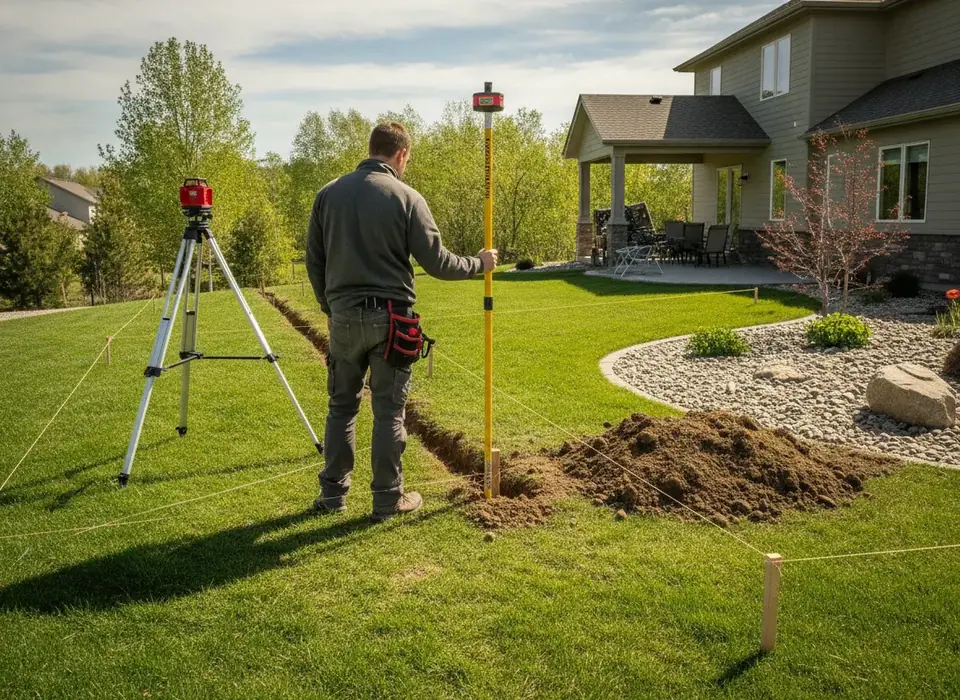
That is why a good site visit starts at the outlet and works backward. The contractor checks where water can legally and safely leave, measures the drop to that point with a level or laser, and then decides how deep the start of the trench can be. If you are still working out where your water can go, read where a French drain should outlet first.
How much slope does a French drain need?
A widely used rule of thumb is a fall of at least 1% along the pipe, which works out to about 1 inch for every 8 to 10 feet, or roughly 1/8 inch per foot. Many contractors prefer more fall when the lot allows it, because a steeper pipe flushes silt better. Very flat lots are where problems start: the pipe ends up nearly level, water sits in it, and fine soil settles out.
- Ask how the slope will be checked. A laser level or transit on the trench bottom is common. Eyeballing it is not enough on a flat lot.
- Ask what happens if there is not enough fall. Options include a shallower start, a different outlet, regrading, or a small sump basin with a pump. Each changes the price.
- Ask where the high and low points are. You should be able to see them on a sketch.
What Tulsa clay changes
About 47% of Tulsa County is mapped as soils with high or very high shrink-swell clay, and the single largest soil, Dennis silt loam (20.6% of the county), is rated "somewhat poorly drained" by USDA. In practical terms, rain soaks in slowly. Water sits on top of the clay or moves sideways along it instead of sinking.
That has three effects on depth:
- Deeper is not automatically better. A trench cut deep into dense clay can collect water that has nowhere to go if the outlet is shallow. In slow soils the drain works as a collector that carries water away, not as something that soaks it into the ground.
- Surface water often needs a shallow drain. If the problem is a soggy lawn after a storm, the water is near the surface. A shallow drain, or a fix to grade and downspouts, may solve more than a deep trench.
- Fabric and gravel matter. Silty clay can work its way into gravel over time. Ask how the contractor plans to keep fines out of the stone and pipe, and whether there will be a cleanout for flushing.
Rain timing matters too. Tulsa averages 40.96 inches of precipitation a year, with about 12.3 days that bring an inch or more, and May is the wettest month (NOAA 1991 to 2020 normals).
How wide should the trench be?
Width follows the pipe and the gravel. A common yard drain uses a 3 or 4 inch perforated pipe with a few inches of washed gravel on every side, which lands most trenches between about 6 and 12 inches wide. Wider trenches hold more gravel and more water during a storm, but they also mean more digging, more stone and more lawn to repair.
Ask what pipe the contractor plans to use. Rigid perforated PVC and corrugated pipe are both common. Rigid pipe is easier to clean and keep on grade; corrugated is cheaper and bends around obstacles. Either can work when it is laid on a steady slope with a way to flush it.
Before anyone digs: Oklahoma law requires anyone digging for hire to contact OKIE811 at least 48 hours ahead (excluding weekends and holidays). It's free. Sprinkler lines and other private lines aren't marked, and at 18 to 24 inches a trench can easily cross them. See our OKIE811 guide for what that means for your project.
How depth affects price
Deeper trenches take longer to dig, need more gravel and create more spoil to haul or spread. Published Tulsa estimates put a French drain at about $23 to $36 per linear foot (HomeBlue, May 2024). Fixr lists exterior drains nationally at $10 to $100 per foot, with curtain drains around $10 to $25 per foot and footing drains around $80 to $100 per foot (Fixr, Jan 2025). Those are published estimates, not quotes, and Tulsa companies' quotes vary.
If a quote looks high, depth is one of the first things to ask about. For the full breakdown of length, outlet distance, roots and sod repair, see the Tulsa French drain cost guide or the shorter cost per foot explainer.
Signs the planned depth may be wrong
- The plan is very deep in one spot, but the outlet is a pop-up emitter only a few inches below the lawn.
- Nobody asked where the water comes from: roof, uphill neighbor, a low spot, or water against the slab.
- The trench runs right beside the foundation with no explanation of how it relates to the footing.
Good drainage can help reduce moisture swings in Tulsa's clay soils, but a French drain is not foundation repair. If you are seeing cracks or sticking doors, that is a question for a foundation specialist, who works in a different trade.
Getting depth right on your quote
When you compare companies, ask each one to write down the start depth, end depth, trench width, pipe type, fabric, gravel and outlet. Matching those lines up is the fastest way to see whether two prices describe the same job. Our guide to comparing drainage quotes has a checklist you can use, and the French drain installation page covers how contractors handle the job from start to finish.
Tulsa French Drain Pros is a free matching service, not a drainage contractor. Describe the problem once on the free quote form and independent local drainage companies can reply with quotes. There is no obligation to hire anyone.
Questions people ask
How deep is a typical French drain in a Tulsa yard?
Most residential yard drains are dug roughly 12 to 24 inches deep, and curtain drains that intercept water moving downhill often go somewhat deeper. There is no single required depth. The outlet height and the slope available across the run usually decide it, so ask each contractor to write down the start and end depth on the quote.
How much slope does a French drain pipe need?
A common rule of thumb is at least a 1% fall, about 1/8 inch per foot or 1 inch every 8 to 10 feet. More fall helps the pipe flush silt. On very flat Tulsa lots there may not be enough drop to reach the outlet, which can mean a different outlet, regrading or a sump basin.
Is a deeper French drain better in clay soil?
Not automatically. Tulsa's clay soils take in water slowly, so a French drain mainly collects water and carries it to an outlet. Digging deeper than the outlet allows just creates a trench that holds water. If the problem is surface water on the lawn, a shallow drain or better grading often does more.
How wide should a French drain trench be?
Many yard drains are about 6 to 12 inches wide, enough for a 3 or 4 inch perforated pipe with washed gravel on all sides. Wider trenches hold more water during a storm but add digging, stone and lawn repair. Ask what pipe, fabric and gravel the contractor plans to use.